


Ramallah – MIFTAH, represented by Youssef Dajani, on behalf of the Board of Directors, recently participated in a high-level ministerial conference on strengthening women’s roles in post-conflict societies in the Arab region and the lessons learned from around the world. The conference, which was attended by Arab and international officials, was held on November 20 and 21 in Cairo, Egypt.
Opening remarks were given by UNDP Gender Team Leader Mrs. Frances Guy, Ivan Surkos, head of the European Union delegation in Egypt and Dr. Haifa Abu Ghazaleh, Assistant Secretary-General and head of the Social Affairs Sector at the League of Arab States, followed by a special session for presentations by ministers of the member states on the Women Peace and Security agenda.
The conference included the presentation of a number of working papers, which focused on the vital role of women in peacebuilding and mediation during the occupation, political transition and conflict in paving the way for post-conflict priorities.
At the conference, Palestinian Minister of Women’s Affairs, Amal Hamad presented a paper entitled, “Women, Peace and Security Agenda and the challenges of occupation and the lack of accountability”.
'مفتاح' تشارك في أعمال المؤتمر الوزاري حول 'تعزيز دور المرأة في مجتمعات ما بعد الصراع في المنطقة العربية'
تاريخ النشر: 28/11/2019
بقلم: مفتاح

رام الله – شاركت المبادرة الفلسطينية لتعميق الحوار العالمي والديمقراطية "مفتاح" ممثلة بيوسف دجاني عضو مجلس ادارة المؤسسة مؤخراً، في أعمال المؤتمر الوزاري حول تعزيز دور المرأة في مجتمعات ما بعد النزاعات في المنطقة العربية: الدروس المستفادة من جميع أنحاء العالم، والذي عقد يومي 20 و 21 من تشرين الثاني في العاصمة المصرية بمشاركة وزراء ومسؤولين عرب ودوليين.
وكانت اعمال المؤتمر افتتحت بعدد من الكلمات الترحيبية لفرانسيس جاي من برنامج الأمم المتحدة الإنمائي UNDP، وإيفان سوركوس رئيس بعثة الاتحاد الأوروبي لدى جمهورية مصر العربية، ود. هيفاء أبو غزالة الأمين العام - رئيس قطاع الشؤون الاجتماعية بجامعة الدول العربية، تلاها جلسة خاصة حول مداخلات وزراء الدول الأعضاء حول أجندة المرأة والأمن والسلام.
بعد ذلك، بدأت أعمال الجلسة الأولى من المؤتمر، والتي اشتملت على مجموعة من أوراق العمل، كان عنوان أولاها: الدور الحيوي للمرأة في بناء السلام والوساطة تحت الاحتلال، خلال الانتقال السياسي ومرحلة الصراع لتحديد أولويات مرحلة ما بعد الصراع.
وخلال الجلسة هذه قدمت آمال حمد وزيرة شؤون المرأة بدولة فلسطين ورقة عمل بعنوان" أجندة المرأة والأمن والسلام في ظل تحديات الاحتلال وغياب المساءلة، تلاها ورقة عمل لوزير التضامن الوطني والأسرة وقضايا المرأة بالجمهورية الجزائرية الديمقراطية الشعبية غنية الدلية وكانت بعنوان "الدور الحيوي للمرأة في بناء السلام خلال فترة الانتقال السياسي".
أما الدكتورة بسمة إسحاقات وزيرة التنمية الاجتماعية بالمملكة الأردنية الهاشمية، فكانت ورقة العمل المقدمة من قبلها بعنوان:" الإعلان الوزاري الرابع لحقوق المرأة للاتحاد المتوسطي )القاهرة 2017 (: المبادئ التوجيهية للمرأة والأمن والسلام.
في حين قدمت خولة مطر نائبة المبعوث الخاص للأمين العام إلى سورية المستشارة نعيمة جبريل، ورقة عمل بعنوان: مشاركة المرأة في مفاوضات السلام والحوارات السياسية في كل من دولة ليبيا والجمهورية العربية السورية: الفجوات والتحديات والدروس المستفادة.
أما الجلسة الثانية من أعمال المؤتمر، فكانت بعنوان:" دمج النوع الاجتماعي في مرحلة ما بعد الصراع: بناء الدولة وتوفير الخدمات والسلع الأساسية في مرحلة ما بعد الصراع واشتملت هذه الجلسة على عدة أوراق عمل من أبرزها: دور لجنة الطوارئ لحماية المرأة خلال فترة الصراعات المسلحة لدينا دواي مدير إدارة المرأة والأسرة والطفولة بجامعة الدول العربية.
وأجندة المرأة والأمن والسلام ودمج منظور النوع الاجتماعي في مسألة توفير الخدمات الأساسية، لريم أبو حسان وزيرة الشؤون الاجتماعية السابقة بالمملكة الأردنية الهاشمية.
وإصلاح البنية التشريعية المراعي للنوع الاجتماعي ما بعد الصراع: التحديات والدروس المستفادة لسماح مرمش المدير التنفيذية لشبكة النساء القانونيات.
ثم استراتيجيات مكافحة العنف ضد المرأة: آليات الحماية ومراكز الايواء في العالم العربي: الممارسات المثلى التحديات والفجوات لوفاء بن مصطفى رئيس تحالف البرلمانيات العربيات، ودمج منظور النوع الاجتماعي في عملية الإصلاح الأمني وجمع السلاح وتفكيك الكتائب وإعادة تأهيل المسلحين لجنيك كوكلر القائم بأعمال المدير الإقليمي لهيئة الأمم المتحدة للمرأة.
وفي الجلسة الثالثة من اليوم الثاني من أعمال المؤتمر، والتي حملت عنوان:" دمج النوع الاجتماعي في جهود الاغاثة والتعافي وإعادة الاعمار"، قدمت عدة أوراق عمل من بينها: "دمج منظور النوع الاجتماعي في جهود الاغاثة والتعافي وإعادة التأهيل وربط النظرية بالتطبيق الفعلي لمارينا فرايلا رئيس القسم السياسي في بعثة الاتحاد الأوربي لدى جمهورية مصر العربية
واعتبارات في تخطيط وتنفيذ التعويضات للناجيات من الانتهاكات الجنسية المرتبطة بالصراع في العراق لشيوفان سيموجوكي من منظمة الهجرة الدولية
ثم جهود الأمم المتحدة الاغاثية في المنطقة العربية: السياسات والتطبيق والأبعاد المتعلقة بالنوع الاجتماعي لريدان السقاف، مسؤول الشؤون الاجتماعية باللجنة الاقتصادية والاجتماعية لغربي آسيا )الاسكوا( / مركز المرأة
ودمج المنظور الاجتماعي في البنية التحتية في فترة ما بعد الصراع: تحديات إعادة الإعمار في الموصل ومدن أخرى لآنا سواف، مديرة مشروع الأمم المتحدة للمستوطنات البشرية في العراق ثم ورقة عمل بعنوان:" دمج النوع الاجتماعي في معالجة التطرف العنيف ومسألة العائدات: ما هي السياسات التي تعالج قضية العائدات من منظور النوع الاجتماعي في المنطقة العربية ؟ وما هي الممارسات المثلى / التحديات / الفجوات، امكانيات التعاون الإقليمي والحوار في المنطقة العربية للزهراء لنقي خبيرة في النوع الاجتماعي وفض النزاع وبناء السلام.
أما الجلسة الرابعة، فكانت بعنوان: آليات وأدوات إقليمية لتعزيز دور النساء في النزاع وما بعد النزاع
واشتملت على ورقة عمل بعنوان:" الشبكة العربية لوساطات السلام" للدكتورة هيفاء أبوغزالة الأمين العام المساعد رئيس قطاع الشؤون الاجتماعية بجامعة الدول العربية.
وما هي الفرص التي توفرها شبكات بناء السلام الإقليمية؟ للسفيرة سعاد شلبي عضو شبكة النساء الوسيطات لدول حوض المتوسط وإنشاء أندية للسلام الرسمي وغير الرسمي وأصدقاء الوساطة في مجتمعات ما بعد الصراع، لأمينة حسن – وسيطة والمديرة التنفيذية المبادرة النسائية للتنمية المجتمعية المستدامة.
ثم "ملاحظات للتفكير حول الشبكات الدولية للوساطة" لألسكندر برمابل من مشروع الوسطاء معهد الدراسات العليا في جينيف. وأخيرا قدمت ورقة عمل بعنوان:" قياس التقدم المحرز في أجندة المرأة والأمن والسلام في المنطقة العربية للزهراء لنقي، خبيرة في النوع الاجتماعي وفض النزاع وبناء السلام
MIFTAH Highlights 'Assassinated Justice' at CSW70 virtual Parallel Event
Date posted: March 12, 2026
By MIFTAH

Ramallah – The Palestinian Initiative for the Promotion of Global Dialogue and Democracy (MIFTAH) organized a virtual parallel event on 10 March 2026 during the 70th session of the Commission on the Status of Women (CSW70), titled “Assassinated Justice: Palestinian Women Between Genocide and Ethnic Cleansing.” The event brought together more than 95 participants from around the world, including human rights advocates, feminist activists, researchers, and representatives of international organizations, networks and coalitions.
The discussion highlighted the concept of “Assassinated Justice” and examined the realities facing Palestinian women amid escalating violations in the occupied Palestinian territory. MIFTAH addressed the severe challenges Palestinian women face in accessing justice, particularly in light of discriminatory U.S. measures in 2025 that restricted the ability of Palestinian women to participate physically in global forums such as CSW, contradicting the session’s theme of “Access to Justice.” The event also underscored the launch of a digital advocacy campaign by Palestinian feminist organizations aimed at raising awareness of these challenges and advocating for inclusive justice.
Speakers—legal experts, feminist advocates, and human rights activists—presented different dimensions of the situation facing Palestinian women. Human rights consultant Mervat Rishmawi discussed Israel’s violations of international law in the occupied Palestinian territory and the growing collapse of accountability mechanisms. Shadia Al-Ghoul, Head of MIFTAH’s Gaza Office, provided updates on the conditions facing women in Gaza amid the ongoing genocide and humanitarian crisis.
Human rights advocate Milena Ansari addressed the layered injustices experienced by Palestinian women in Israeli detention, highlighting patterns of systemic violations and the denial of fundamental rights. Dr. Rula Sarras from the Rural Women Development Society (RWDS) shed light on the realities of rural Palestinian women facing escalating settler violence and land confiscation, supported by testimonies from the ground. Kefaya Khreim, International Advocacy Officer at the Women’s Centre for Legal Aid and Counselling (WCLAC), focused on gendered crimes, including sexual violence, and the persistent denial of justice for Palestinian women. Speakers emphasized the intersection of occupation, forced displacement, militarization, and gender-based violence, and how these factors collectively undermine Palestinian women’s rights, dignity, and security.
The event concluded with a call for international accountability, urgent global action, and inclusive justice frameworks that amplify Palestinian women’s voices and lived experiences. MIFTAH affirmed that Palestinian feminist voices will continue to advocate for justice and human rights despite attempts to silence or marginalize them on international platforms.
MIFTAH holds conference in Ramallah and Gaza, calling for Participatory and Complementary Governance as Public Policy
Date posted: February 11, 2026
By MIFTAH
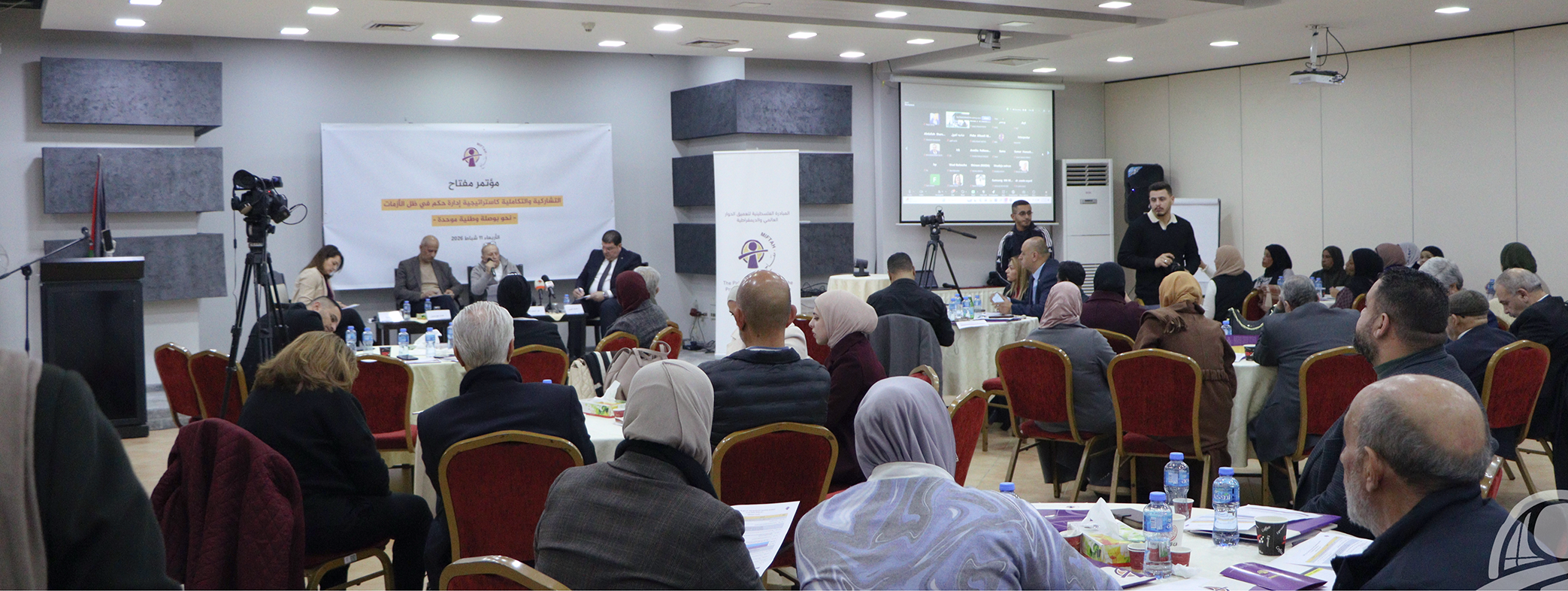
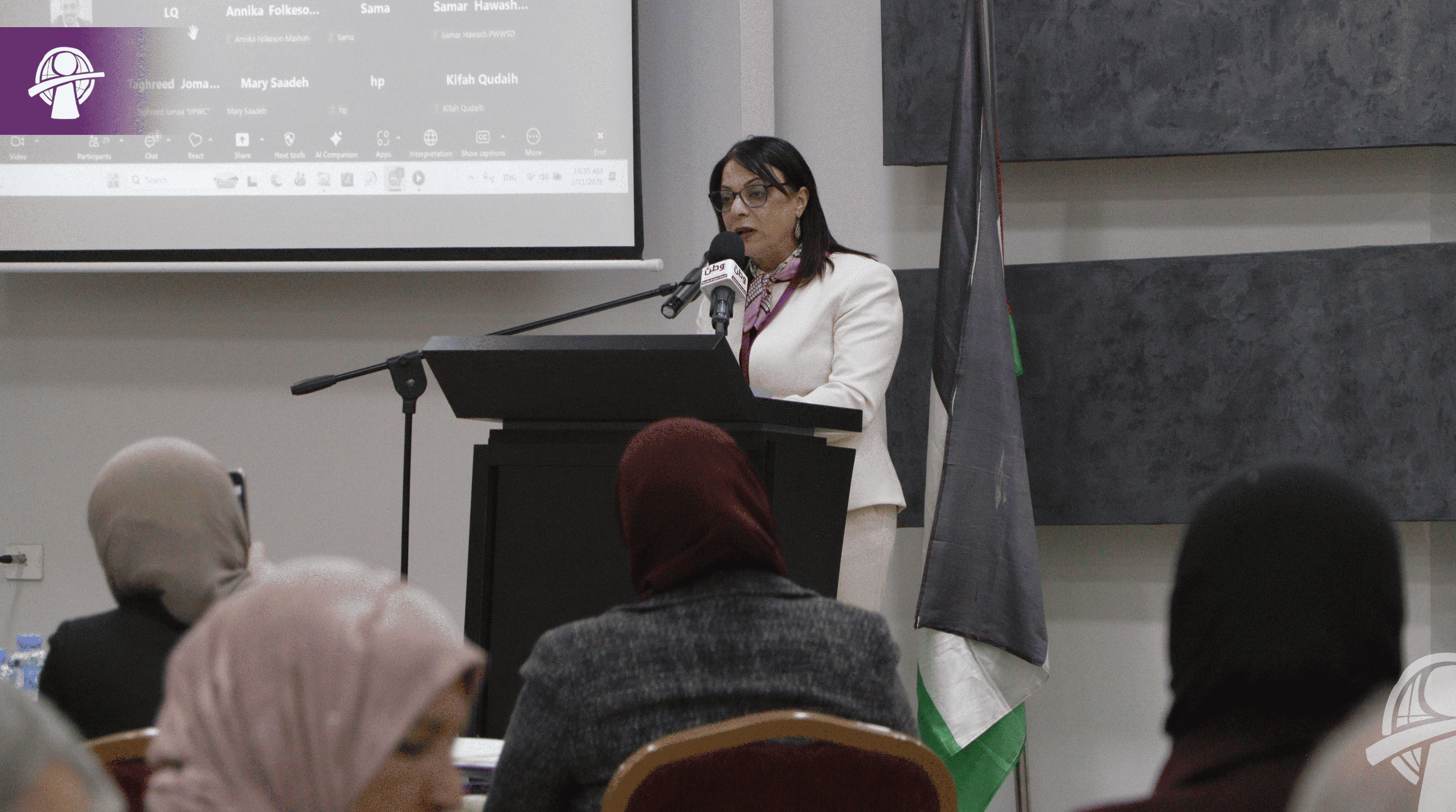
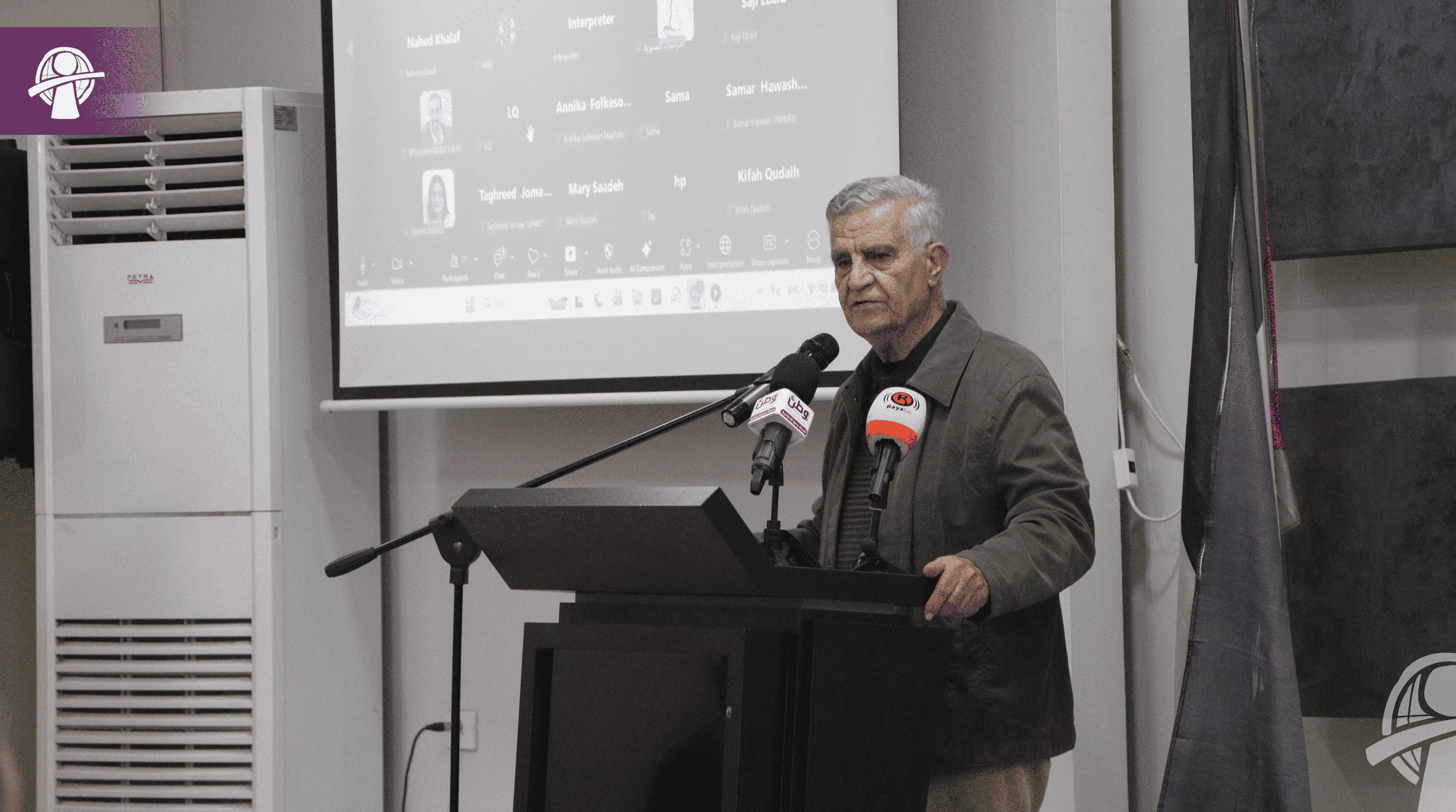
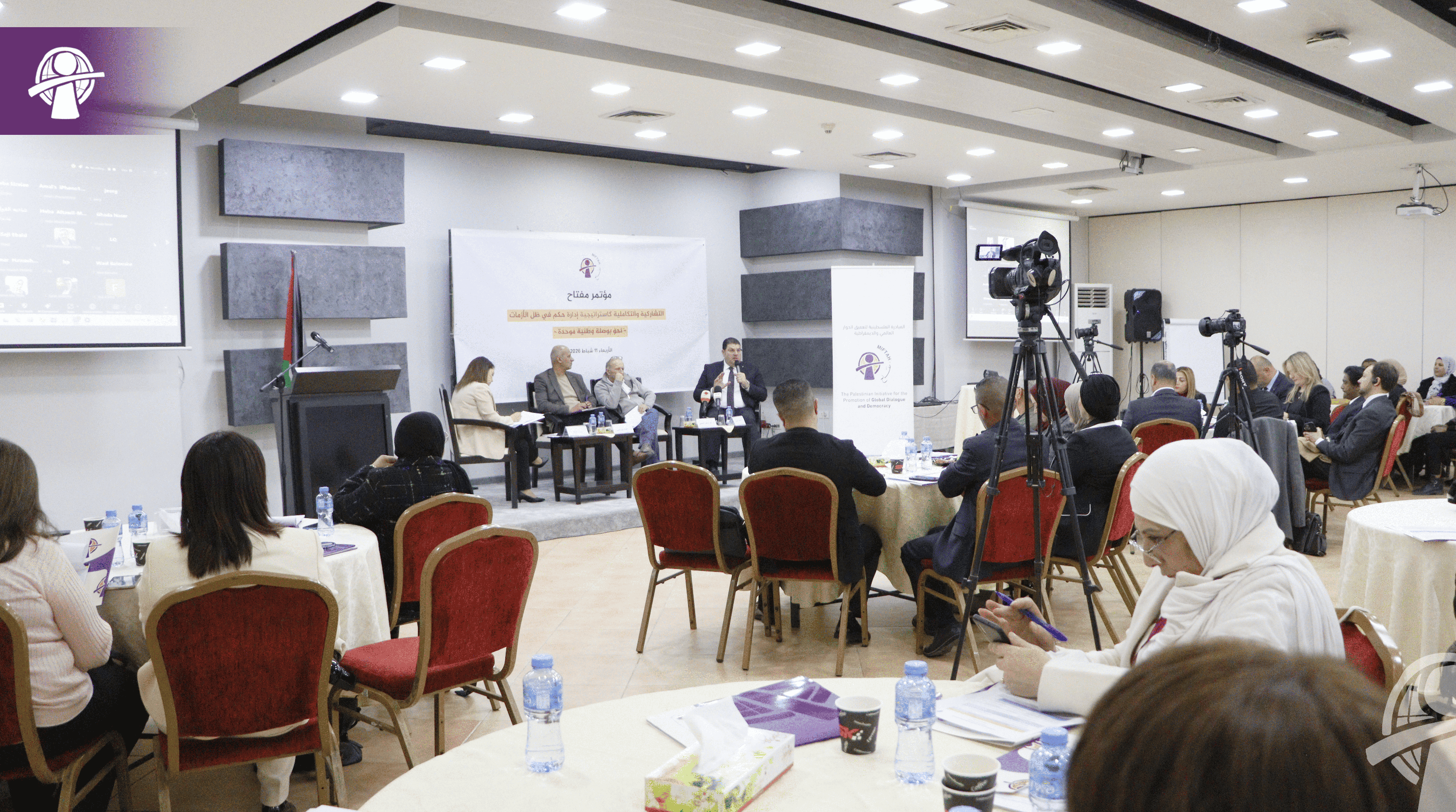
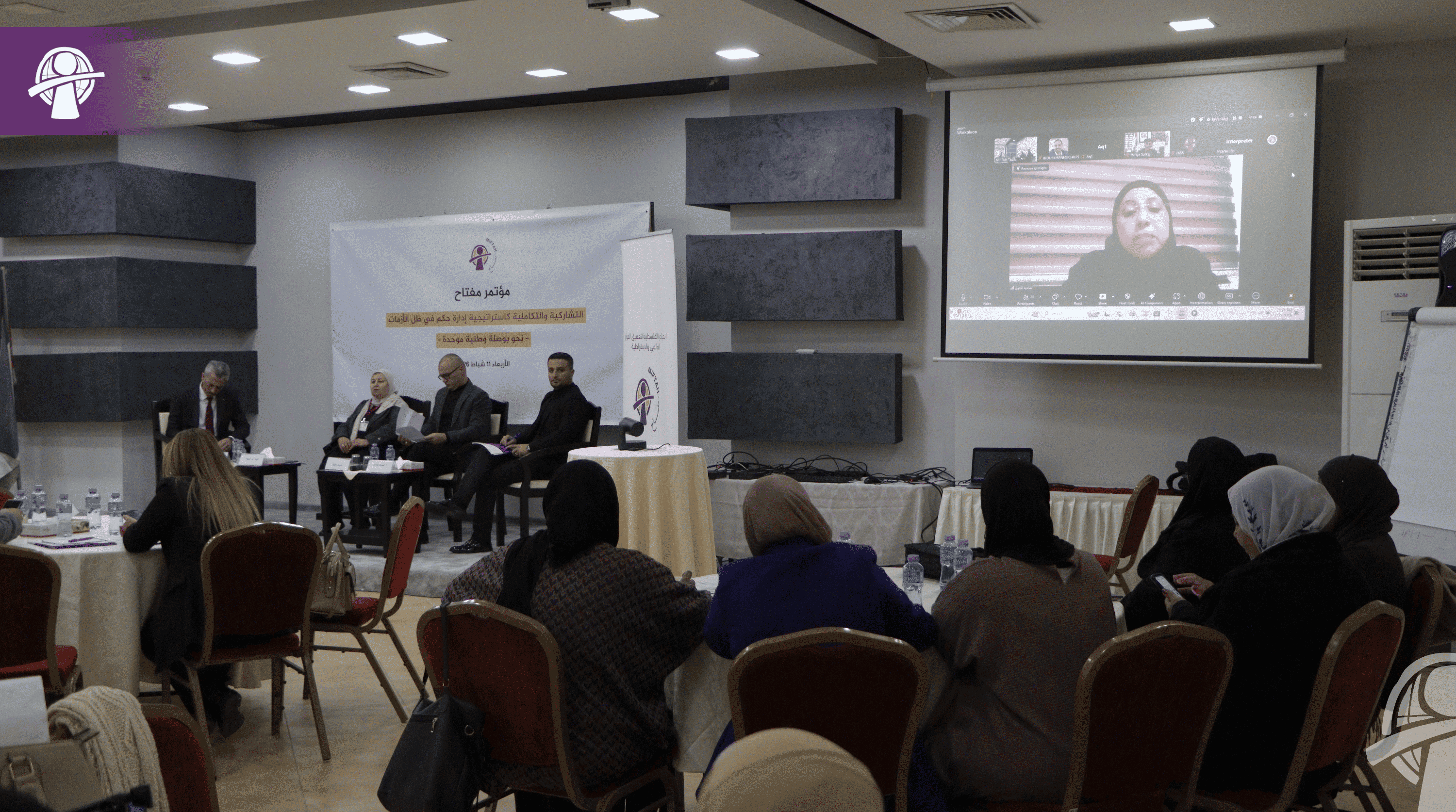
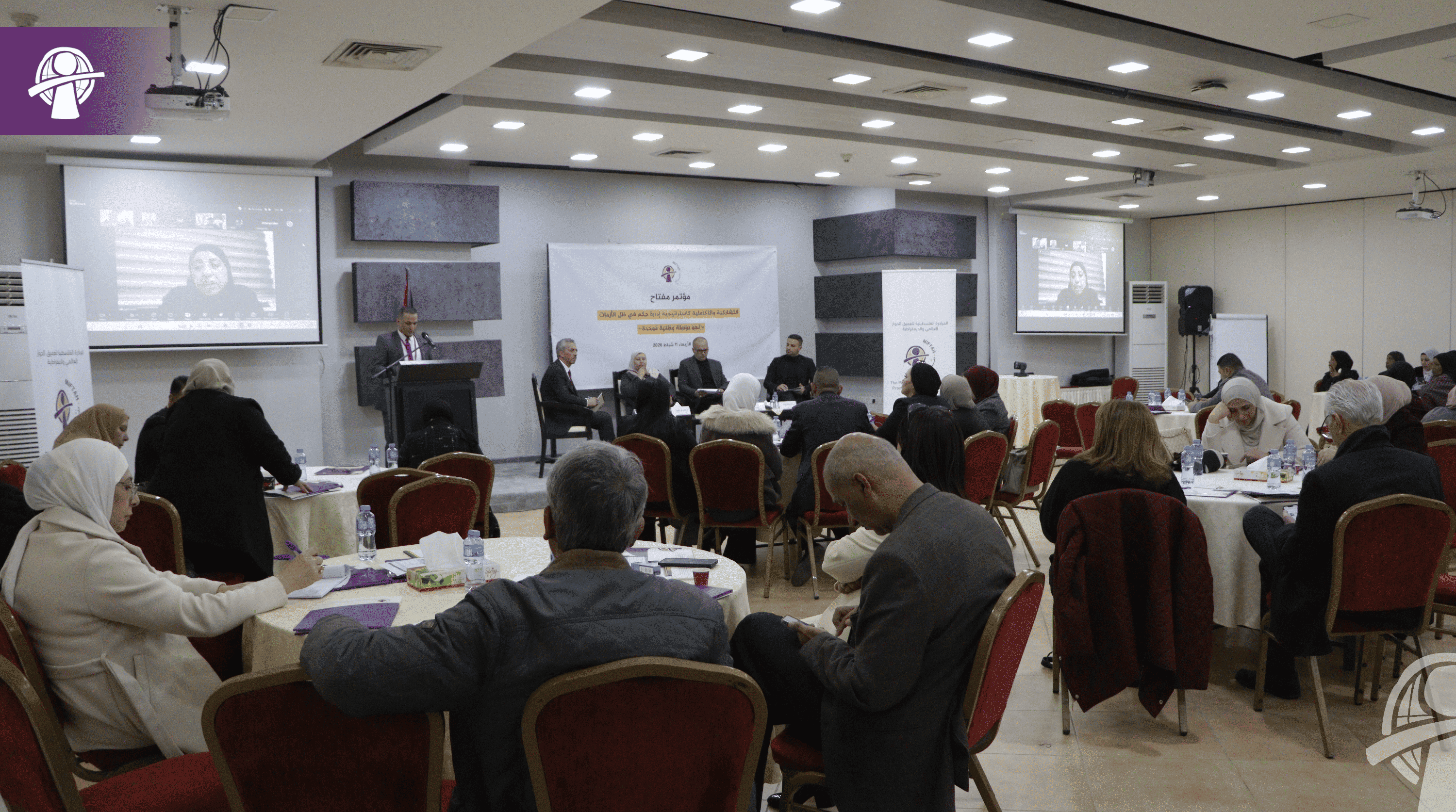
Ramallah – On February 11, MIFTAH held a conference entitled, “Participation and Complementarity as a Strategy of Governance amid crises”, in Ramallah and simultaneously, in Gaza, via Zoom. The conference was attended by a wide spectrum of government representatives, local councils, civil society institutions, popular committees, researchers and academics, in addition to representatives from international institutions.
The conference addressed how the Palestinian people’s existence is being targeted along with their ability to survive and remain steadfast amid the genocide in the Gaza Strip, escalating settlement policies and forced displacement from the West Bank, including Jerusalem. It showed how these complex crises exposed the diminishing effectiveness of the Palestinian institutional structure, the limitations of a centralized model of governance and its inability to singularly respond to the needs of society and protect the social fabric.
The participants reiterated that participation and complementarity between the government, civil society, local councils and popular committees is no longer an administrative option or a procedural improvement, but a national and structural necessity to ensure steadfastness and the ability to manage crises, and preserve social unity and Palestinian geographic integrity in the face of the escalating colonialist onslaught.
They indicated that the absence of the Palestinian Legislative Council (PLC) prompted CSO’s to reconsider public policies and contribute to the development of perspectives on governance, provide practical alternatives that promote national unity and reorganize the relationship between the state and society on the basis of participation and complementarity.
The participants reiterated that experience in the field in the West Bank and Gaza Strip proved that local councils, popular committees and grassroots organizations, played a pivotal role in protecting citizens and providing basic services during times of government capacity collapse. They stressed that ignoring these roles or administratively confining them exacerbated fragility rather than hindering it.
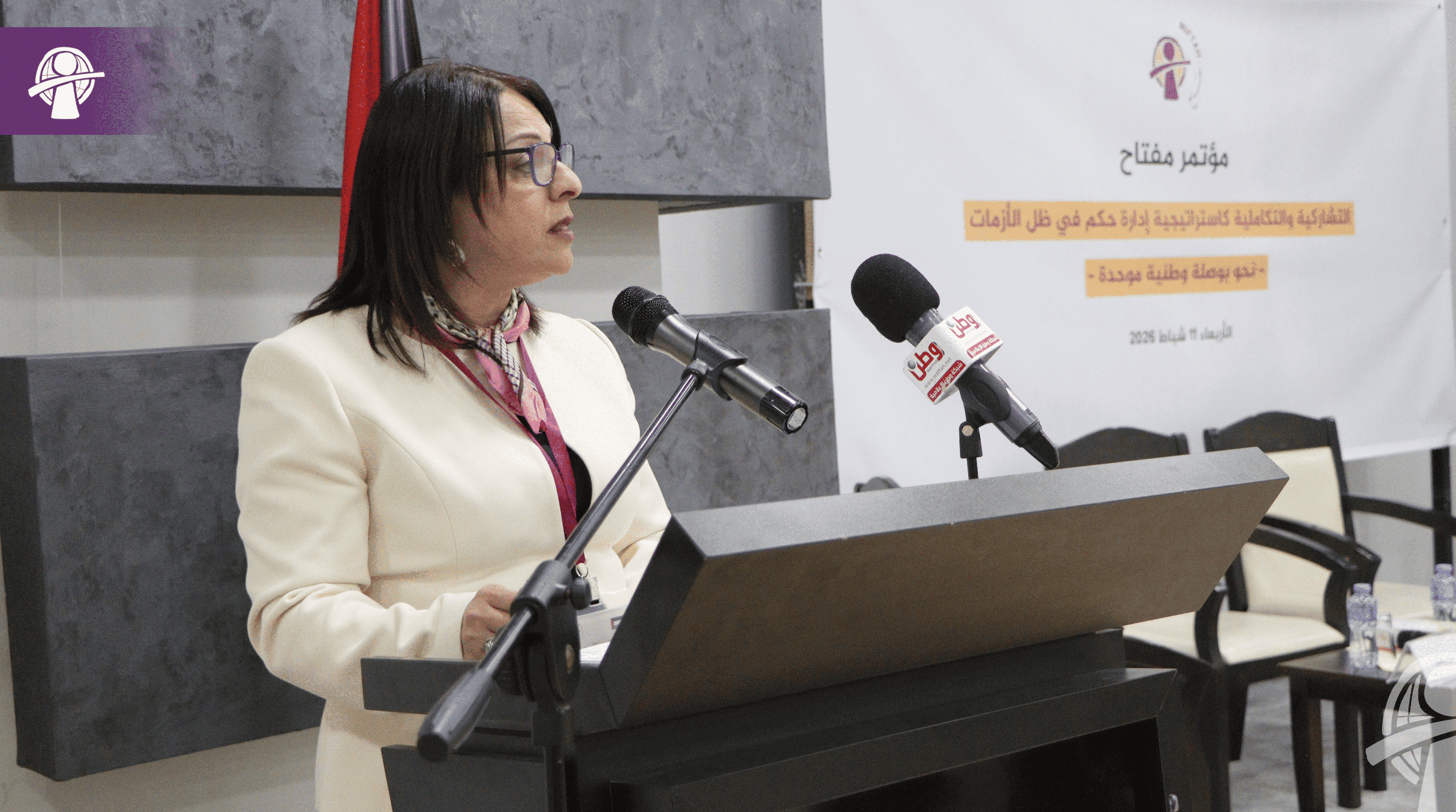
MIFTAH Executive Director, Dr. Tahreer Al Araj, gave the opening address, maintaining that, “What our people are enduring is no longer a temporary emergency awaiting an end, but a prolonged condition –left alone with no actual administration – and which has repercussions on people’s everyday lives.” She maintained that ‘this stage exposed the magnitude of the crime committed against us, but at the same time has exposed the structural fissures and the limitations of this model of governance, when it is centralized or when it manages crises based on the mentality of “putting out fires”, not one of protection, planning and sustainability”.
Al Araj added that, “When governance is based on participation and complementarity between roles, society becomes more capable of enduring and living. We saw this in the refugees camps, in marginalized villages and in cities, besieged by policies and decisions. Popular committees, municipalities, grassroots initiatives, youth and women’s organizations thus constituted the front line of defense of society, not as an alternative to anyone, but as an integral part of a system of governance in times of crisis.
Dr. Azmi Shuabi, member of MIFTAH’s Board of Directors, also proposed MIFTAH’s concept of adopting the principle of participation and complementarity in governance as a public policy and a unifying national framework for this stage. He said this was based on certain pillars, including: unity of the system of references, whereby there is official and civic partnership on the basis of complementarity not replacement, and a distribution of responsibilities according to ability, endurance and justice.
Shuaibi reiterated that in light of settler encroachment and threats of eviction, expansion and attacks, protection becomes a function of governance and not merely a slogan. It requires systems of civil response, legal support, documentation, early warning, psychosocial support, service protection lines and emergency interventions that prevent areas from being vacated. Shuaibi said it was imperative that preventing expulsion and displacement become an operational government priority, through the provision of planning, resources, services and institutional presence.
The first session, moderated by Maram Zaatara, MIFTAH’s Good Governance Program Director, focused on how participation and complementarity can be translated into government policy. Dr. Mohammed Al Ahmad, Chairman of the Permanent Reform Committee, spoke on the Government’s vision for adopting a complementary- participatory policy with civil society, while Dr. Abdel Rahman Tamimi, strategic planning expert, spoke about civil society’s vision of participation and complementarity and their mechanisms from the perspective of a broader civil society. Meanwhile, Issam Haj Hussein, AMAN Executive Director, addressed the issue of accountability as a tool for promoting participation and complementarity, while PNGO Director, Amjad Shawa outlined what was required from the National Technocrat Committee and the government in the next phase, to protect the role of CSOs in the current situation.
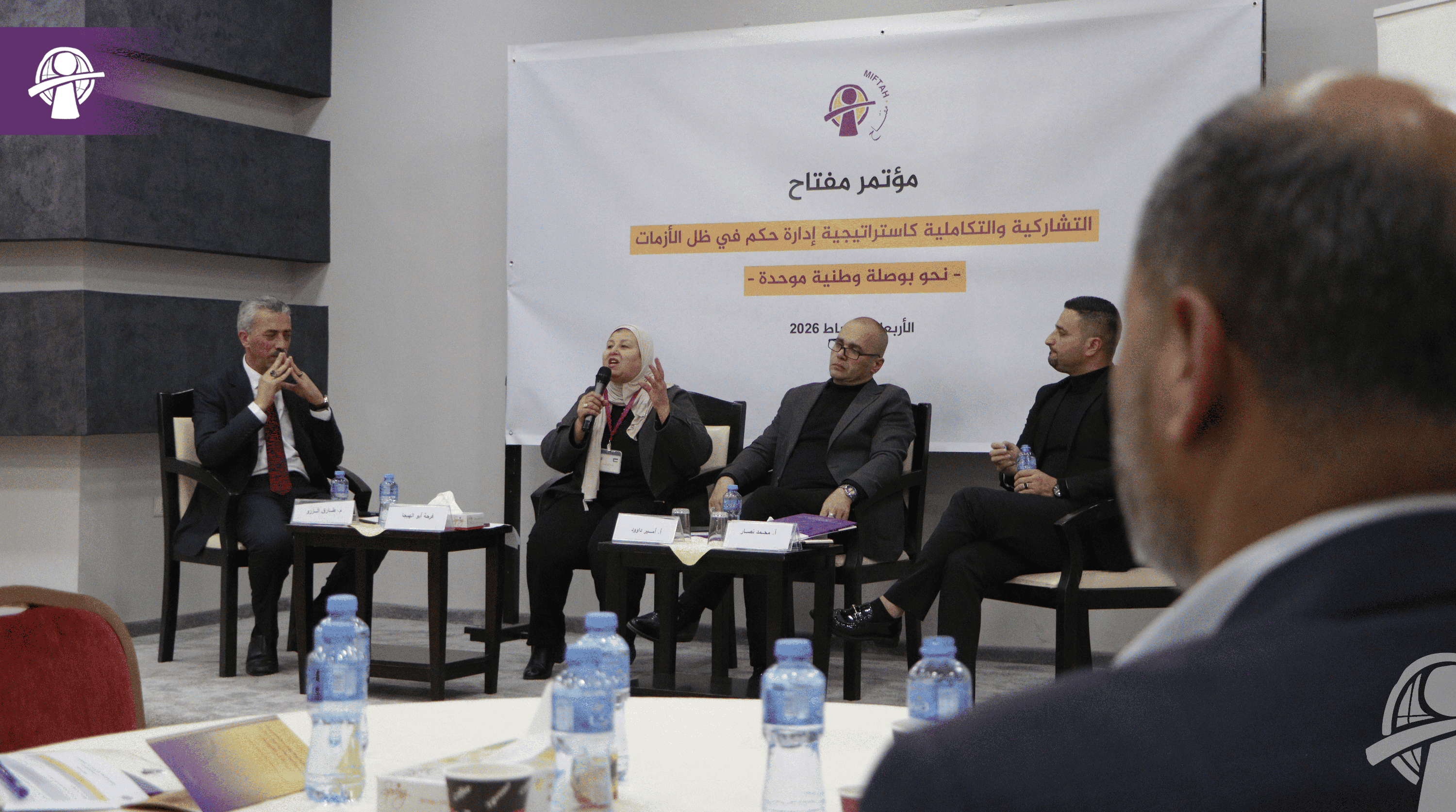
The second session, moderated by Shadia Al Ghoul, Head of MIFTAH’s Gaza office, discussed ways to preserve a unified national framework in light of these crises, and concerns over a fragmented collective entity. General Manager of Documentation at the Wall and Settlement Resistance Commission Amir Daoud, discussed the commission’s vision in this context, while Gaza City Mayor Yehya Sarraj, spoke about local bodies operating under a genocide and the Gaza municipality model. Tareq Zaru, Head of the Coordinating Council of the Professional Associations Complex, and Mohammad Nassar, Director of the Private Sector Coordination Council, spoke about the vision of the private sector. Furthermore Farha Abu Al Heija , Head of “Not to Forget Association” in Jenin Refugee’s camp, spoke on the role of popular committees in refugee camps during times of crises, with the Jenin camp as a model.
This was followed by MIFTAH Public Policies Officer, Uhoud Mraqtan, who presented the recommendations and closing statement of the conference.
Adopting participation and complementarity as a National Government Policy
The conference closed with a number of general agreements, calling for adopting the principle of “participatory and complementary governance” as a public policy for this phase: a unified national framework.
The conference reiterated the institutional and legislative structural unity between the West Bank and Gaza Strip as a fundamental and legal reference, and the rejection of any permanent formula of fragmentation.
It called for the adoption of official-civil partnership in planning emergency priorities and ensuring services and societal oversight, while respecting roles and not replacing them.
The conference called for considering social protection and preventing expulsion as a central government function, managed at the official/civil level and according to a clear rights-based logic. It called for establishing permanent national red lines, the right to self-determination and statehood, the right to protection of society, refusal to depoliticize the cause and rejection of any arrangements that cancel out or fragment national representation, while strengthening international solidarity on this basis.
Reinforcing the role of local players in crisis management
The conference called for recognizing the pivotal role of local councils, especially in emergency contexts, and building on the experiences of the Gaza Municipality and popular committees in the Jenin Camp as two national models that can be evaluated, developed and circulated.
It also called for developing a legal and institutional framework for popular committees in the camps that guarantee the sustainability of their role as legitimate social structures, especially in light of the challenges faced by the refugee cause. The participants stressed on the need to move from impromptu responses to sustainable and participatory crisis management, based on planning, resource integration and linking social interventions with fair and transparent spending plans.
Accountability and societal trust
Promoting the mechanisms of societal accountability as a complementary element of participation, ensures justice in the distribution of resources, protects civil action from politicization and polarization and contributes to rebuilding trust between society and institutions of governance.
The conference closed by emphasizing that confronting the escalating colonialist onslaught cannot be achieved through closed, centralized instruments or top-down approaches. Instead, it requires a model of national governance grounded in participation and complementarity. This model should be based on mutual recognition of roles and the revival of social structures. It must operate within a unifying national framework that protects the unity of society and geography and promotes Palestinian steadfastness.
At the close of the conference, MIFTAH reiterated its commitment to continuing this discussion and building on the conference’s outcomes. It will work to transform these outcomes into sustainable policy and dialogue pathways. These efforts aim to push the Palestinian government to adopt a policy of participation and complementarity in governance. They also seek to lay the groundwork for a model of local governance that reflects the will of society and protects its unity, at one of the most dangerous and complex stages in contemporary Palestinian history.
MIFTAH holds open dialogue entitled 'Challenges facing the Palestinian political system'
Date posted: November 27, 2024
By MIFTAH
- The institutional relationship between the PA and the PLO
- The relationship between the political system and international organizations, with a focus on UNRWA as a case study
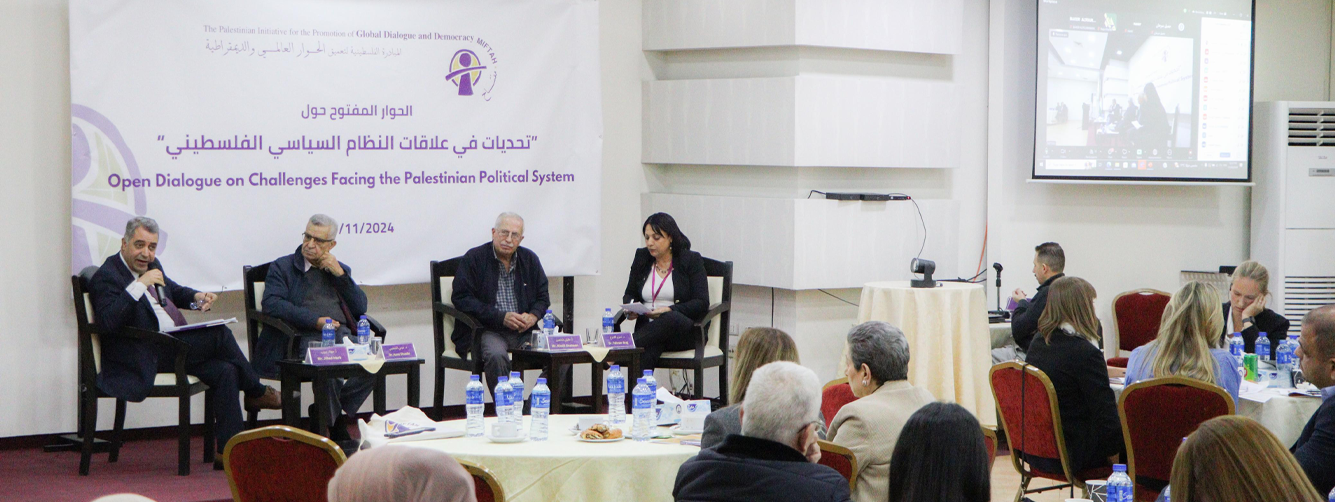
On November 20, 2024, the Palestinian Initiative for the Promotion of Global Dialogue and Democracy (MIFTAH) held a hybrid-style open dialogue entitled “Challenges facing the Palestinian political system” at the Red Crescent Headquarters in Al Bireh. The conference shed light on the challenges facing the Palestinian political system and the escalating political and humanitarian situation after the 37th Israeli government under Benjamin Netanyahu took office at the end of 2022.
The conference brought together several experts, scholars, analysts and political and national figures, in addition to official institutions, diplomatic missions, NGOs, INGOs and university students. Its focus was on pressing issues within the Palestinian political system, especially in light of the genocide against the Palestinian people and its subsequent political repercussions.
MIFTAH’s objective was to hold a discussion on political courses of action and proposals that could help develop a joint Palestinian vision for confronting challenges to the internal Palestinian relationship between the PLO and PA and relationships with international organizations, including the inflammatory Israeli assault on UNRWA.
The conference’s interventions focused on two major points: the first session discussed the institutional relationship between the PA and PLO, while the second session focused on the political system’s relationship with international organizations, with UNRWA as a case study.
In her opening address, Dr. Hanan Ashrawi, Chair of MIFTAH’s Board of Directors, stated that the PA was created as one arm of the PLO and that the relationship between the PLO and PA must be clear and integral. She stressed how the PLO is the entity that shouldered the responsibility of protecting the Palestinian people’s rights and cemented their national identity. Ashrawi called for finding ways to revive the PLO and revitalize its institutions and to discipline the relationship between it and the PA in order to achieve its national goals. She maintained this should be far-removed from slogans but rather, focused on practical steps to galvanize its role in local and international arenas.
Dr. Azmi Shuaibi, member of MIFTAH’s BoD highlighted the historical roots of the problematic relationship between the PA and the PLO, tracing the political transformations since the Palestinian declaration of independence in 1988 to today. Shuaibi indicated that the PA was created by a decision from the PLO Executive Committee, but then branched off without a clear framework to determine the institutional relationship between the two parties. He maintained that the only solution lies in a reassessment of the shape and form of the PA and the reinforcement and independence of the PLO’s role.
Opening the session, MIFTAH Executive Director, Dr. Taheer Araj, said the procedures adopted by the current Israeli government fall within a clear plan to permanently eliminate the Palestinian cause. Araj ascertained that the Israeli occupation is very clear on its intentions to continue its genocide of the Palestinians to forcibly displace them, not only as a future step but one applicable in the near future.
The conference coincided with the ongoing escalation of Israeli violations against the Palestinian people, including increasing violence, settlement expansion and settler attacks in addition to the genocide on the Gaza Strip, which began on October, 2023. The Israeli government is also continuing to undermine the PA through attempts to destroy it financially and politically and by classifying PLO factions and Palestinian national movements as “terrorist” all of which threaten the stability of the Palestinian political system. The participants also discussed the ongoing Israeli assault on official and international Palestinian institutions, including UNRWA.
The final segment of the conference was a discussion of Palestinian options for facing these challenges, with a focus on the need to develop a joint Palestinian vision at the internal and international levels, to guide Palestinians in their struggle for freedom and independence and to end the genocide on occupied Palestinian land.