


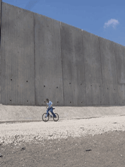
In 1967, the boundaries of Anata, located in the Jerusalem Governorate, extended over 30,000 dunums (7,500 acres) of land.1 However, multiple Israeli policies affecting the town since then have led to its progressive loss. According to the Anata Local Council, upon completion of Wall construction, only some 2,300 dunums (575 acres) will remain for the use of Anata residents, the majority of which has already been built-up. Israel has appropriated or isolated the rest through construction and expansion of Israeli settlements, establishment of a major military base, and construction of the Wall and its “buffer zone”.
Anata’s natural expansion is now restricted by “facts on the ground” created by Israel. Upon completion of the Wall, Anata and the adjacent Shu’fat Refugee Camp will be enclosed on 3 sides by the Wall. To the east, natural expansion will be prevented by a major road currently under construction, and, to its east, by the Israeli military base of Anatot. Hemmed in by physical structures on all sides, intense overcrowding is likely to occur as the Palestinian civilian population grows over time.
The economic future of Anata is equally bleak. Some 45 per cent of Anata’s labourers depend on work in Israel, and a significant proportion of Anata residents rely on commerce that depends, in large part, on traffic in and out of the town. Completion of the Wall and further Israeli restrictions on Palestinian freedom of movement will contribute to a decrease in commercial trade and in overall income levels.
The damage caused to Anata’s economy will be felt on a national level. Approximately 35 per cent of the Palestinian economy is dependent on Metropolitan East Jerusalem, which extends from Bethlehem to Ramallah. This metropolitan area is now being broken into semi-enclaves – of which Anata is but one – by the route of the Wall. The disintegration of Metropolitan East Jerusalem destroys the possibility of an integrated national economy and thus the possibility of a viable Palestinian state.
While Israel has carried out its policies in the Anata area under a variety of pretexts, including “security”, the facts on the ground clearly indicate that these policies are part of a series of unilateral Israeli actions designed to sever the connection between Occupied East Jerusalem and other parts of the West Bank, to de facto annex Palestinian land and to impose a vision of “final status” that will impede the establishment of a viable, contiguous Palestinian state.
To View the Full Report as PDF (287 KB)
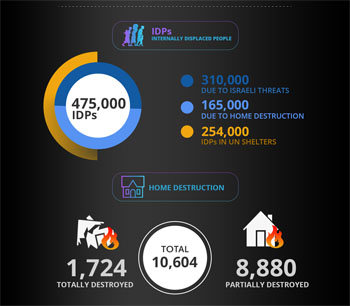
Israeli Assault on Gaza By Numbers in 30 Days
Date posted: August 09, 2014
By Safa Agency
Special Report - Creating a Semi-Enclave: Focus on Anata, Jerusalem Governorate
Date posted: June 17, 2006
By Palestinian Monitoring Group
In 1967, the boundaries of Anata, located in the Jerusalem Governorate, extended over 30,000 dunums (7,500 acres) of land.1 However, multiple Israeli policies affecting the town since then have led to its progressive loss. According to the Anata Local Council, upon completion of Wall construction, only some 2,300 dunums (575 acres) will remain for the use of Anata residents, the majority of which has already been built-up. Israel has appropriated or isolated the rest through construction and expansion of Israeli settlements, establishment of a major military base, and construction of the Wall and its “buffer zone”.
Anata’s natural expansion is now restricted by “facts on the ground” created by Israel. Upon completion of the Wall, Anata and the adjacent Shu’fat Refugee Camp will be enclosed on 3 sides by the Wall. To the east, natural expansion will be prevented by a major road currently under construction, and, to its east, by the Israeli military base of Anatot. Hemmed in by physical structures on all sides, intense overcrowding is likely to occur as the Palestinian civilian population grows over time.
The economic future of Anata is equally bleak. Some 45 per cent of Anata’s labourers depend on work in Israel, and a significant proportion of Anata residents rely on commerce that depends, in large part, on traffic in and out of the town. Completion of the Wall and further Israeli restrictions on Palestinian freedom of movement will contribute to a decrease in commercial trade and in overall income levels.
The damage caused to Anata’s economy will be felt on a national level. Approximately 35 per cent of the Palestinian economy is dependent on Metropolitan East Jerusalem, which extends from Bethlehem to Ramallah. This metropolitan area is now being broken into semi-enclaves – of which Anata is but one – by the route of the Wall. The disintegration of Metropolitan East Jerusalem destroys the possibility of an integrated national economy and thus the possibility of a viable Palestinian state.
While Israel has carried out its policies in the Anata area under a variety of pretexts, including “security”, the facts on the ground clearly indicate that these policies are part of a series of unilateral Israeli actions designed to sever the connection between Occupied East Jerusalem and other parts of the West Bank, to de facto annex Palestinian land and to impose a vision of “final status” that will impede the establishment of a viable, contiguous Palestinian state.
To View the Full Report as PDF (287 KB)